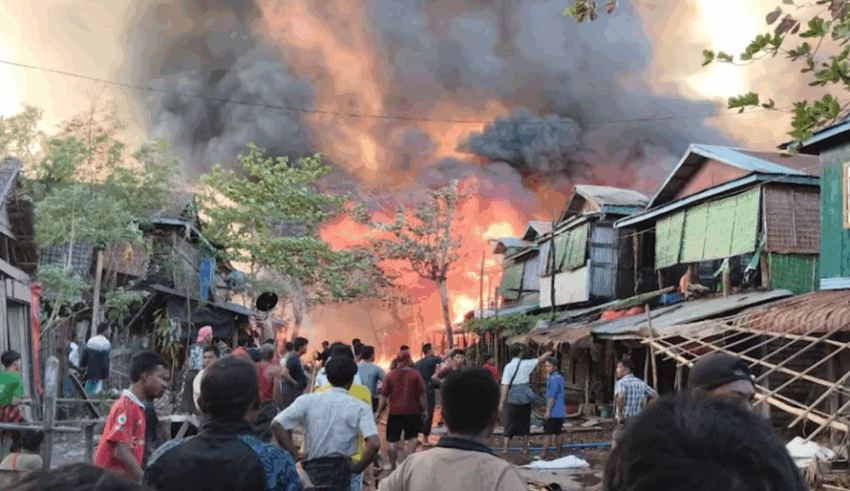
Myanmar, a country often in the international spotlight for its political instability and human rights abuses, has faced the wrath of natural disasters over the years, from cyclones to floods. The recent earthquake, with a devastating magnitude of 7.7, that struck the country has once again put the spotlight on the regime’s handling of disaster relief and its broader implications for human rights in the country. The natural disaster led to more than 3 million people being displaced, and the death toll has risen to more than 3 thousand. The earthquake is not just an event that brought devastation, but a stark reminder of the ongoing struggle for human dignity and justice under Myanmar’s military rulers.
Myanmar’s military seized power in 2021 from the democratically elected government, creating a significant armed resistance and constant violent clashes. In the wake of the earthquake, however, a temporary ceasefire has been announced between the guerrilla groups and the military regime, so as to better prioritize the well-being of their citizens and offer disaster relief. Nonetheless, the military regime’s response was characterized by delays, a lack of transparency, and, at times, denial of aid. Many communities are left without proper shelter, medical aid, or access to food, neglecting basic human rights, which underscores the junta’s selective support, limiting the humanitarian aid in areas where opposition to the government is strong.
International aid organizations and local activists have frequently reported that the military government has obstructed the delivery of relief supplies to areas outside of their control. Instead, the military has prioritized its own interests, manipulating aid distribution to strengthen its power over affected populations and punish regions that have shown resistance to the regime. Indeed, as the military controls access to relief efforts, they can coerce local populations into submitting to their authority or, conversely, punish dissenting areas by withholding support.
Moreover, it has been reported that in ethnic minority regions, the military has taken advantage of the chaos following the earthquake to strengthen its presence and tighten control: minorities such as the Karen, Rohingya, and Kachin, who were already marginalised, found themselves in an even more critical situation following the earthquake, with major risks of violence, displacement, and neglect by the regime. Despite the military being accused of human rights abuses, and sanctioned by the international community, little these actions have affected the ruling power of the country.
While Myanmar’s military regime has made it clear that it has little regard for international pressure, the international community must continue to hold the junta accountable for its actions. The United Nations and various human rights organizations have condemned the military’s human rights abuses and called for stronger sanctions and a halt to military aid. However, these measures have had limited success in forcing the regime to change course. Even more now, following the earthquake, the international community has condemned the junta for not allowing foreign aid to flow into the country: in particular, it is mentioned that humanitarian assistance arrived from China, but that military guards started shooting at the Red Cross trucks, forcing them to stop.
So far, countries have pledged millions in assistance to help Myanmar and humanitarian aid organizations with population assistance and reconstruction projects. India, which competes with China for influence in the country, has been especially quick and generous with assistance. Multiple other countries have sent rescue teams, including Turkey, Vietnam, Singapore, and Malaysia. Even the US government has pledged $2 million in emergency aid and sent a three-person team to assess how best to respond given drastic cuts to US foreign assistance (The Associated Press, 2025).
In conclusion, the earthquake in Myanmar has highlighted the profound human rights issues the country faces under military rule. The junta’s refusal to prioritize the well-being of its citizens and its obstruction of aid underscore the systemic violations that have characterized Myanmar’s political landscape for decades. The earthquake serves as both a tragedy and a critical reminder that Myanmar’s people deserve not just disaster relief but also freedom and justice. Nonetheless, the natural disaster has led to a historical ceasefire between the military junta and the opposition militias. It’s too early to say whether this pause could lead to something longer-lasting, as it would require active diplomacy and major international support and control to ensure a stable agreement, but it still can be affirmed that it might be an initial step to guarantee basic human rights to Myanmar’s population.
Resources:
The Associated Press (2025) Myanmar’s military declares a ceasefire as earthquake deaths pass 3,000, published by NPR, available at: Myanmar’s military declares a ceasefire to ease quakas deaths pass 3,000 : NPR
By The European Institute for International Relations