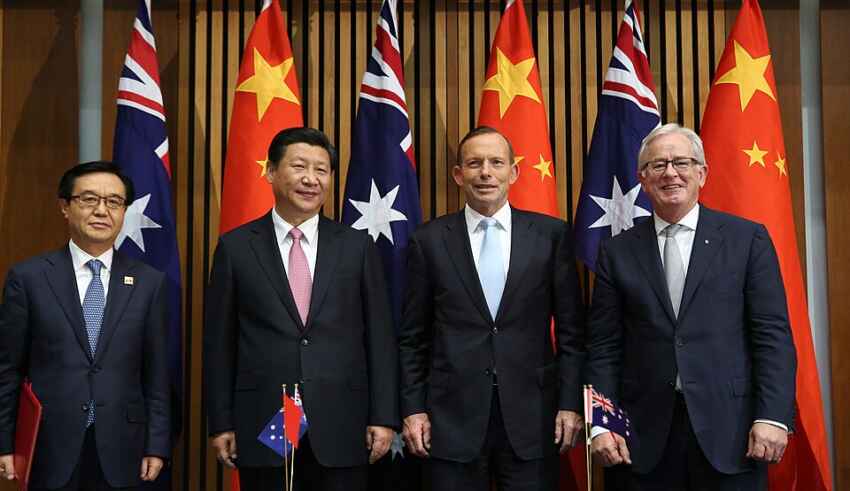
Australia is navigating one of the most complex foreign policy challenges in its modern history. The escalating rivalry between the United States and China is reshaping the global order, especially in the Indo-Pacific. With deep economic ties to China, which is responsible for over a third of the country’s exports, and enduring security alliances with the United States, Australia finds itself in between two Superpowers. The question is not merely whether Australia wants to balance relations between these superpowers, but whether such a balance is still feasible in a period in which the US and China are going through a new Cold War era.
Australia’s relationship with the United States is grounded in the past: since World War II, the US alliance has been of strategic importance for Australia’s military defence and intelligence capability. In particular, the 1951 ANZUS Treaty marked the beginning of joint military exercises and intelligence-sharing through the Five Eyes alliance, marking officially a deep-rooted partnership. More recently, the AUKUS agreement further strengthened Australia’s ties with the US, promising nuclear-powered submarines and advanced military technology.
In contrast, China’s rise as an economic powerhouse has transformed Australia’s economic landscape. China accounts for nearly a third of Australia’s total exports, particularly in iron ore, coal, wine, and education services. While trade has brought prosperity, it has also created dependence.
As such, the intensification of US-China rivalry places Australia under growing pressure. Washington increasingly expects its allies to take a firmer stance against China, particularly on issues like military activities in the South China Sea and technological competition over semiconductors and AI. At the same time, the global tariff war initiated by President Trump has reached Canberra, leading the continent to distance itself from Washington. According to the BBC, the fiscal year of 2024 led to national revenue of $212 billion from exports to Asia, while the US market “only” accounted for $37 billion of Australian goods, making it clear that if posed with a choice, Canberra will maintain its economic alliance with China rather than the US.
The concept of non-alignment or neutrality is no longer viable in a polarized geopolitical environment. Traditional diplomacy aimed at hedging between two giants may no longer be sustainable: Australia will certainly need to strengthen its sovereignty in decision-making, avoiding becoming a pawn in Superpower competition. Similarly, it should diversify economic dependencies and reduce its reliance on the Chinese market. Recent trade agreements with India, the UK, and Europe are already promising signs for this.
As the US-China rivalry is getting stronger and more complicated, it is essential that Australia manages to balance relations between Washington and Beijing: it will require more than diplomatic approaches, it will demand economic transformation, regional leadership, and the formulation of an independent foreign policy vision. Indeed, in the contemporary world, balance is no longer about equidistance; it’s about resilience, adaptability, and strategic clarity.
By The European Institute for International Relations