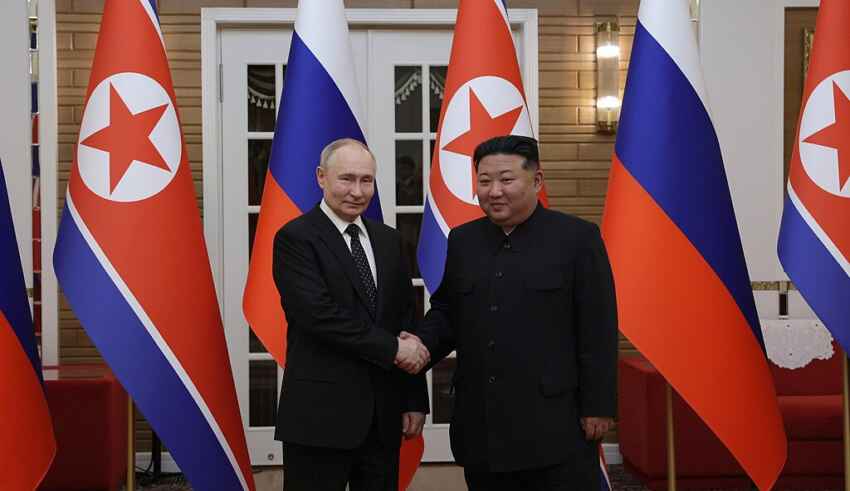
North Korea’s increasing military support for Russia amidst the ongoing Russo-Ukrainian War marks a significant shift in global strategic alignments. What began as Pyongyang supplying troops, artillery, and ballistic weaponry has evolved into a complex partnership that intertwines military, technological, and economic interests. While Russia reaps immediate wartime benefits, North Korea strategically utilizes this cooperation to bolster its defense industry, circumvent sanctions, and gain diplomatic leverage. This relationship is far from mere convenience; it represents a calculated alliance with profound geopolitical implications.
North Korea’s contributions to Russia’s war effort include reinforcements, munitions, and critical weapon systems that have not only filled Russia’s immediate gaps but have also showcased Pyongyang’s capacity to meet wartime demands on a global scale. For Moscow, these supplies and the deployment of North Korean troops—albeit at significant human cost—have provided much-needed resources to sustain its campaign. Simultaneously, North Korea’s defense industry has flourished, with Kim Jong Un prioritizing increased production and modernization of arms manufacturing facilities, enabling Pyongyang to meet both its internal military objectives and external commitments.
Beyond material exchanges, the partnership highlights deeper security and technological ties. Russia’s provision of advanced technologies, ranging from reconnaissance drones to satellite systems, has enabled North Korea to modernize its military capabilities, including its outdated navy and air force infrastructure. Such transfers risk amplifying Pyongyang’s destabilizing potential in Northeast Asia, further challenging the security dynamics in the region.
The strategic implications of this cooperation extend far beyond the battlefield. North Korea’s expanded defense capabilities, coupled with Russia’s willingness to facilitate technology transfer, pose a direct threat to neighboring states and undermine international efforts to curb proliferation. Furthermore, the diplomatic fallout of this alliance could prolong existing tensions between North Korea and the United States, as Pyongyang remains emboldened by Russian support and shows little interest in engaging constructively with Washington or its allies.
However, the partnership also presents a set of pressing challenges for the broader international community. While the United States and South Korea have employed coercive diplomacy to curb the alliance, efforts to restrict arms trade and prevent technology transfers between Russia and North Korea face significant obstacles. Enhanced intelligence-sharing mechanisms and multilateral sanctions enforcement represent vital tools, yet the complex nature of Russo-North Korean cooperation requires sustained vigilance and innovative countermeasures.
Looking ahead, the trajectory of this partnership raises critical questions. Will Moscow’s dependency on Pyongyang wane once the Russo-Ukrainian War ends, as history suggests, or could this alliance persist, driven by mutual strategic interests? How will this cooperation reshape Northeast Asia’s security landscape and influence global geopolitics? Most importantly, can the international community successfully mitigate the risks posed by this partnership without escalating tensions further?
As North Korea solidifies its role as Russia’s wartime ally, the implications for regional stability and global security cannot be overstated. The evolving Russo-North Korean partnership demands a comprehensive response—one that not only addresses immediate threats but also anticipates long-term consequences for international relations and peace.
By The European Institute for International Relations